When Nurses Meet Vibe-Coding: Shifting from Problem Talk to Situated Specification in Participatory Design
† equal contribution
Extended Abstracts of the CHI Conference on Human Factors in Computing Systems (CHI EA '26)
CHI 2026 EA · Extended Abstract
📝Abstract
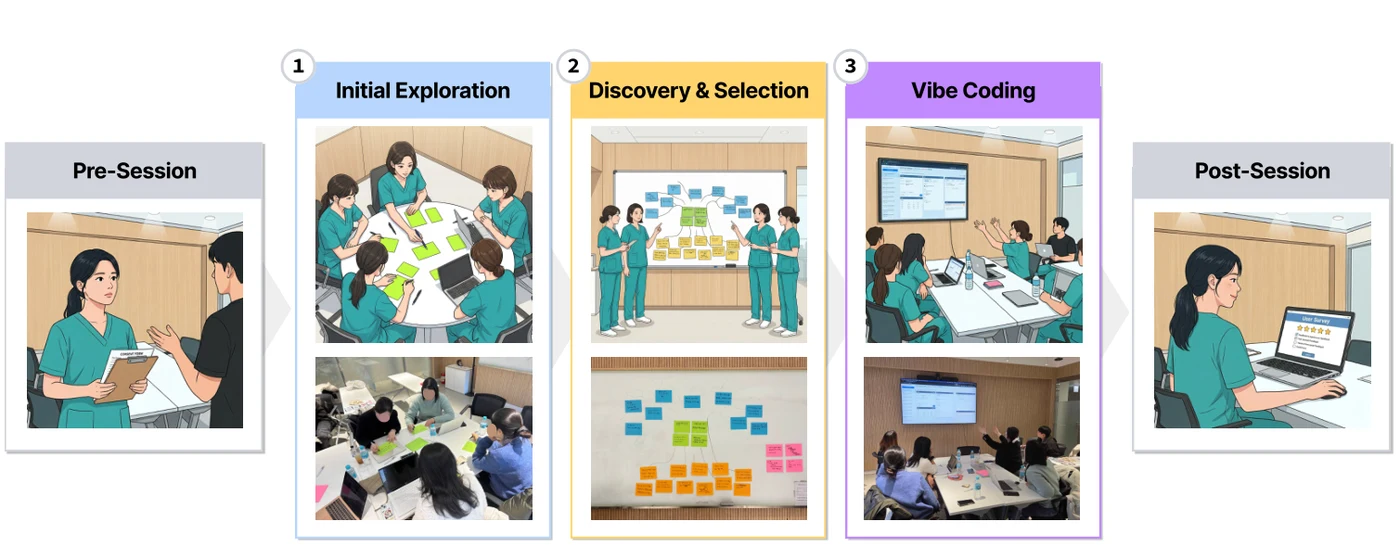
Participatory Design (PD) empowers end-users as co-designers, yet contemporary practice often reduces PD to ideation workshops where users contribute ideas but remain excluded from implementation. This gap stems from an asymmetry in technical knowledge: users cannot experience how their ideas translate into working systems, limiting feedback to abstract problem framing. We conducted a 110-minute workshop with five clinical nurses designing an EMR interface, incorporating real-time “vibe coding”, LLM-assisted prototyping that transforms verbal descriptions into functional interfaces within minutes. Through thematic analysis of utterances and post-session surveys, we observed shifts in design articulation: from abstract problem statements toward situated specifications referencing concrete screen elements, conditional triggers, and failure modes. Participants reported enhanced agency, identifying as co-creators rather than passive informants. We contribute a methodological template for integrating vibe coding into PD and preliminary observations suggesting that real-time implementation may help surface tacit domain knowledge and reconnect implementation with genuine participation.
🔖BibTeX
@inproceedings{kim2026nurses,
  title = {When Nurses Meet Vibe-Coding: Shifting from Problem Talk to Situated Specification in Participatory Design},
  author = {Junghwan Kim and Kieun Park and Jeongwoo Ryu and Hyungwoo Song and Bongwon Suh},
  booktitle = {Extended Abstracts of the CHI Conference on Human Factors in Computing Systems (CHI EA '26)},
  year = {2026},
  doi = {10.1145/3772363.3798470}
}