DEBSIM: Productive Friction for Learning Transfer in LLM-Based Argumentation Tutoring
† equal contribution
Proceedings of the International Conference on Intelligent Tutoring Systems (ITS 2026), Lecture Notes in Computer Science, Springer
ITS 2026 · Full Paper
🏆 Best Full Paper Award
📝Abstract
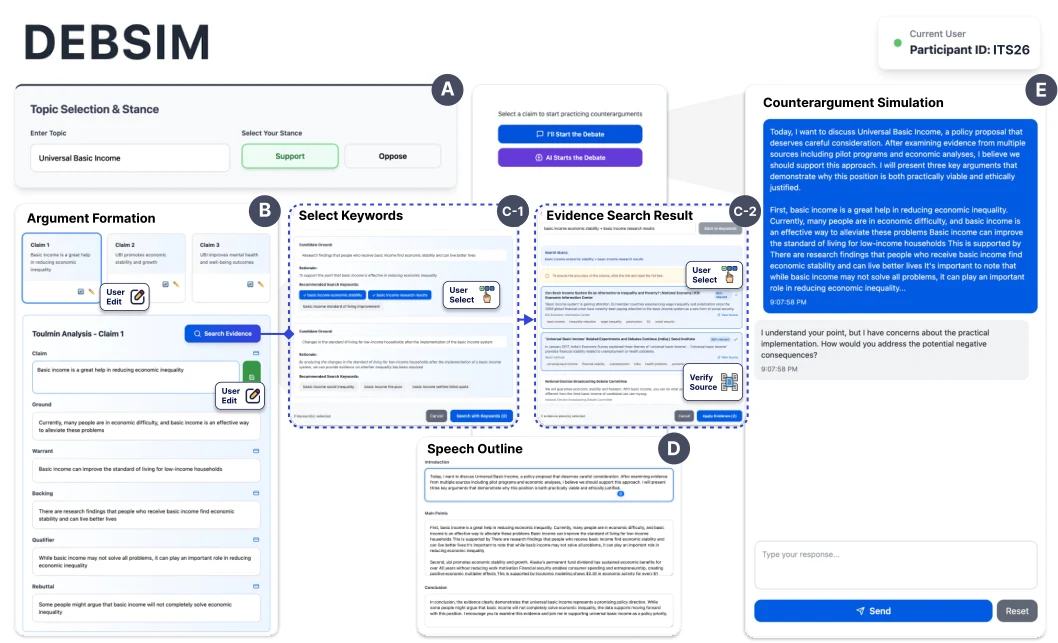
Most argumentation tutoring systems evaluate in-system performance rather than learning transfer, and the generative capabilities of large language models (LLMs) risk bypassing the effortful cognitive processes that tutoring aims to develop, a tension known as the assistance dilemma. We present DEBSIM, an LLM-based argumentation tutoring system that addresses this dilemma through productive friction, scaffolding debate preparation across three stages (Toulmin knowledge component structuring, evidence validation with verification friction, and counterargument simulation) while requiring learner effort at cognitively meaningful decision points. In a within-subjects experiment (N=20), participants prepared with DEBSIM for one debate topic and without it for another, then engaged in live debates without system access. Participants in the DEBSIM condition produced openings with higher knowledge component completeness and shifted toward evidence-based discourse patterns. These findings offer a transfer-based evaluation methodology for argumentation tutoring, preliminary evidence that productive friction can help address the assistance dilemma in the LLM era, and an inner/outer-loop scaffolding architecture for supporting argumentation skill transfer from AI-assisted preparation to unassisted performance.
🔖BibTeX
@inproceedings{kim2026debsim,
  title = {DEBSIM: Productive Friction for Learning Transfer in LLM-Based Argumentation Tutoring},
  author = {Junghwan Kim and Kieun Park and Hyungwoo Song and Bongwon Suh},
  booktitle = {Proceedings of the International Conference on Intelligent Tutoring Systems (ITS 2026), Lecture Notes in Computer Science, Springer},
  year = {2026},
  note = {Best Full Paper Award}
}