CaseSense: Mapping the Legal Case Landscape with Multi-Dimensional Visual Exploration
Proceedings of the 39th Annual ACM Symposium on User Interface Software and Technology (UIST '26)
UIST 2026 · Full Paper
📝Abstract
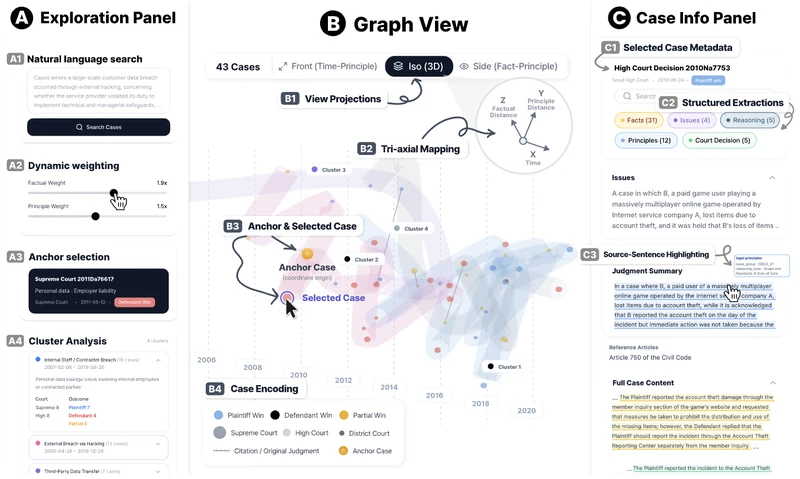
Legal case research requires combining facts, legal principles, and timelines into persuasive arguments. Yet existing retrieval tools return one-dimensional ranked lists, collapsing this structure into a single relevance score. A formative study with five lawyers confirmed this flat output leads to missed cases, temporal gaps, and fragmented reasoning. We present CaseSense, a visual analytics system for multi-dimensional exploration via tri-axial mapping with dynamic weighting, anchor-based navigation, and purpose-constrained view projections. A within-subjects study with 16 legal professionals compared CaseSense against conventional workflows. CaseSense achieved complete key-case discovery in the Fact Synthesis task, with the largest gains in organization and connection identification. Participants adopted task-matched interaction strategies without instructions. These findings suggest encoding domain reasoning dimensions as manipulable spatial axes supports expert sensemaking, while separating spatial organization from AI-generated content preserves verification behavior.
🔖BibTeX
@inproceedings{kim2026casesense,
  title = {CaseSense: Mapping the Legal Case Landscape with Multi-Dimensional Visual Exploration},
  author = {Junghwan Kim and Hyeonseok Jeon and Jung Lee and Dongseok Heo and Bongwon Suh},
  booktitle = {Proceedings of the 39th Annual ACM Symposium on User Interface Software and Technology (UIST '26)},
  year = {2026},
  doi = {10.1145/3830398.3830479}
}